
When working with Electron Beam Lithography (EBL), we normally talk about the electron beam after it has already been generated.
We talk about beam current, aperture, focus, stigmatism, writing patterns and dose.
But I had a more basic question:
Where does the electron beam actually start?
On an EBL system, there can be several electrical parameters related to the electron gun. For example, we may have conditions related to emitter heating, extraction voltage and a high accelerating voltage.
At first, it can look like all of these are simply different settings for producing the beam.
But while learning about the electron gun, I understood that they have different jobs.
The basic process can be thought of as:
Emitter heating → Electron extraction/emission → Acceleration → Electron optics → Usable writing beam
Let’s look at this step by step.
1. Everything Starts From the Electron Emitter
At the top of the electron column is the electron source.
Its job sounds simple:
Produce electrons.
But producing a stable electron beam suitable for nanometer-scale writing is not as simple as connecting a voltage and switching the machine ON.
Different electron sources use different emission mechanisms.
Common electron-source families include:
- Thermionic emitters
- Schottky or thermal field emitters
- Cold field-emission sources
For a heated source such as a Schottky/TFE emitter, both the temperature of the emitter and the electric field around its tip are important.
This was the first thing that helped me understand the electron gun.
Heating, extraction and acceleration are related, but they are not the same process.
2. First: Why Do We Heat the Emitter?
In a heated electron source, electrical power is supplied to the emitter or filament.
We can think about electrical heating using:
P = V × I
where:
- P = electrical power
- V = voltage
- I = current
For resistive heating, we can also write:
P = I²R
This electrical power produces heat.
So we can simplify the first stage as:
Electrical power → Heating → Higher emitter temperature
But why do we need the temperature?
Electrons inside a material do not automatically escape from its surface.
They have to overcome an energy barrier associated with the material’s work function.
Heating provides energy to the electron population.
For a purely thermionic source, sufficiently energetic electrons can escape from the hot surface.
For a Schottky-type source, however, heating is only part of the story.
A strong electric field is also used.
3. What Is IF?
Depending on the equipment terminology, we may see something such as IF, often associated with the filament/heating condition.
The important point is that this should not be confused with the tiny beam current that we later use for writing.
For example, an EBL writing condition might use a probe current in the pA or nA range.
The current involved in heating an emitter can be completely different.
So:
Filament/heater current ≠ final writing beam current
The filament current is related to establishing the operating temperature of the source.
The writing beam current tells us how much electron charge is actually being delivered through the electron-optical system toward the sample.
These are two different parts of the system.
4. Then What Does VE Do?
After establishing the proper emitter condition, we also need an electric field around the electron source.
This is where the extraction condition becomes important.
A strong electric field near a sharp emitter tip can assist electrons in leaving the surface.
For a Schottky emitter, the combination of:
Elevated temperature + Strong electric field
helps produce useful electron emission.
This can be represented simply as:
Emitter heating
↓
Emitter reaches operating temperature
↓
Extraction electric field
↓
Electrons leave the emitter
↓
Emission current is produced
This helped me understand why simply saying:
“We heat the emitter, so electrons come out.”
is incomplete for this type of source.
The electric field is also an important part of the emission process.
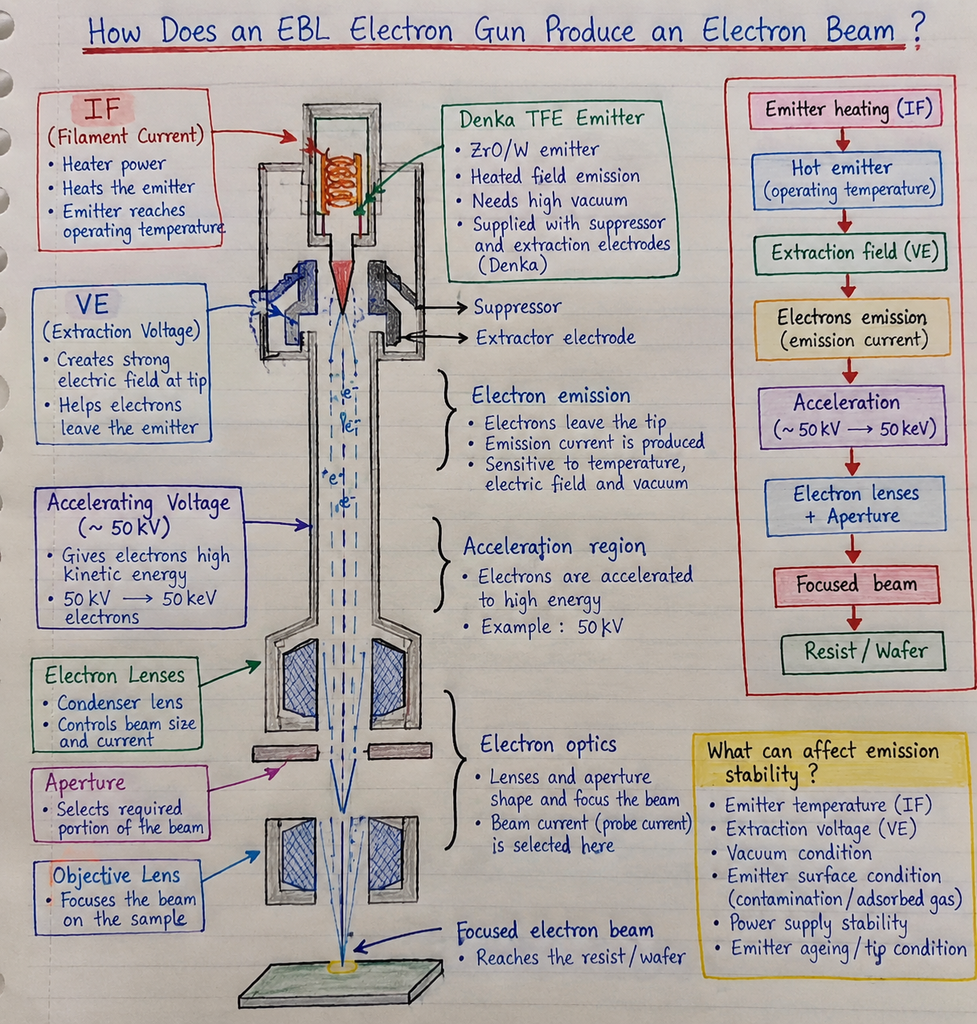
5. So What Is Emission Current?
Once electrons are leaving the source, we can talk about emission current.
Emission current represents electron charge flowing from the source under the operating emission conditions.
But another important distinction is:
Emission current is not necessarily the same as the final probe current at the wafer.
After leaving the source, electrons still have to travel through the electron-optical system.
Some electrons may not become part of the final writing probe.
The beam passes through components such as lenses and apertures before reaching the sample.
Therefore, conceptually:
Emitter
↓
Emission current
↓
Electron optics
↓
Aperture / beam selection
↓
Focused electron probe
↓
Probe current at the sample
This explains how the electron source can operate under one current condition while the actual writing beam can be only pA or nA.
6. Where Does the 50 kV,110,130 Come Into the Picture?
This was another part that initially looked confusing to me.
If the emitter already produces electrons, why do we also need something like a high-voltage system?
Because producing electrons and accelerating electrons are different jobs.
The high accelerating potential gives the emitted electrons kinetic energy.
If an electron is accelerated through a potential difference of approximately:
50 kV
then its kinetic energy is approximately:
50 keV
So the high voltage is not simply there to heat the emitter.
Its role is associated with creating the high-energy electron beam required by the electron-optical system.
A useful way of separating the functions is:
Heating condition
→ establishes emitter temperature
Extraction condition
→ helps establish electron emission from the source
Accelerating voltage
→ gives the electrons high kinetic energy
These three ideas should not be mixed together.
7. Then Why Do Some Gun Controls Show Frequency?
This was one of the most interesting questions for me.
If electron emission depends on temperature and electric field, why might an electron-gun control system also have frequency-related settings associated with some electrical conditions?
The important thing I learned is that we should not automatically interpret this as:
“Electrons are emitted at this frequency.”
The displayed frequency can instead be related to how the particular power supply and control electronics generate, transfer or regulate an electrical condition, especially when high-voltage isolation is involved.
So there are really two different subjects:
Electron-source physics
Temperature + electric field → electron emission
and
Power/control electronics
Voltage, current, frequency, regulation and high-voltage isolation → creating and controlling those required conditions
The exact meaning of a frequency parameter depends on the design of the particular electron-gun power supply.
Therefore, without the electrical documentation for a specific EBL system, it would be wrong to assume that every frequency setting has the same function.
But understanding this distinction already makes the control system much easier to think about.
8. How Do Heating and Extraction Work Together?
Now we can put the pieces together.
Imagine a heated field-emission source.
First, the emitter has to reach its required operating condition.
Electrical power
↓
Emitter heating
↓
Operating temperature
Then an appropriate electric field exists around the emitter tip.
- Extraction condition
↓
Strong electric field near emitter
↓
Electron emission- Then the emitted electrons enter the accelerating field.
- Emitted electrons
↓
High accelerating voltage
↓
High-energy electrons- Finally, the electron optics form the beam that we actually use.
- High-energy electrons
↓
Electron lenses
↓
Aperture
↓
Focused electron probe
↓
Sample / resist
Now the complete process makes much more sense.
9. Why Is the Writing Current So Small?
This also answers another question I had.
If considerable electrical power can be involved around the electron gun, why might the writing current at the sample be only:
pA or nA?
Because we are comparing different electrical quantities.
The heater current is being used to establish the source temperature.
The emission current describes electrons emitted from the source.
The probe current describes the portion of the electron beam that finally reaches the sample under a particular electron-optical condition.
So we should not directly compare them as if they were the same current flowing through one simple circuit.
The EBL column is not just:
Power supply → wire → wafer
It is an electron-optical system.
10. The Complete Picture
After learning this, I now think about the electron gun as several connected stages:
Electrical heating condition
↓
🔥 Emitter reaches operating temperature
↓
⚡ Extraction electric field
↓
Electron emission
↓
⚡ High accelerating voltage
↓
High-energy electron beam
↓
🔬 Electron lenses + aperture
↓
Focused probe current
↓
🎯 Electron beam reaches the resist
This also helped me separate four terms that can easily become confusing:
Heater/filament current
Used as part of establishing the emitter temperature.
Extraction voltage
Helps establish the electric field required around the electron source.
Emission current
Electron current produced/extracted from the source.
Probe/beam current
The electron current finally available in the focused beam at the sample.
They are related, but they are not interchangeable.
What I Understood
Before learning about this, I thought about the electron gun mainly as a high-voltage source producing electrons.
Now I see it differently.
The emitter first needs the correct operating conditions.
For a heated field-emission source, temperature and electric field work together to establish electron emission.
The high-voltage system then accelerates the electrons.
After that, the electron-optical system controls and focuses the beam until only the required probe reaches the sample.
So the journey is not simply:
50 kV → Electron beam
It is closer to:
Emitter condition → Emission → Acceleration → Beam formation → Focused probe
And the frequency values that may appear in an electron-gun controller belong to another important layer of the system: how the power/control electronics generate and regulate those electrical conditions.
That is something I want to understand more deeply next.
Conclusion
An EBL electron beam begins long before the beam reaches the resist.
The electron source must first create stable emission.
For a heated field-emission source, emitter temperature and the electric field around the tip play important roles.
The emitted electrons are then accelerated to high energy, after which lenses and apertures form the usable writing beam.
The biggest thing I learned was that heater current, extraction voltage, accelerating voltage, emission current and final probe current are different parameters with different jobs.
Understanding those differences makes the electron gun much less mysterious.
Heating creates the operating condition.
The extraction field helps produce emission.
High voltage accelerates the electrons.
Electron optics turn those electrons into the beam we finally use for writing.

Leave a Reply